Aerosol Fire Suppression System
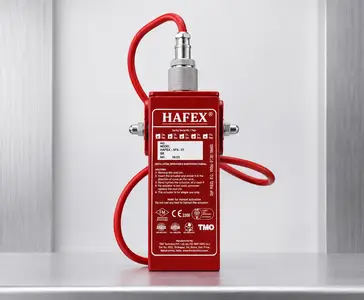
Condensed aerosol fire suppression is the newest and cleanest generation of automatic fire extinguishing technology. Supremex Equipments distributes HAFEX® aerosol fire suppression systems, manufactured by YG Fire Security (Turkey) — a manufacturer producing the largest aerosol fire extinguishing generators in the world in both K and S types, holding 28 trademark patents and operating in 18 countries.
A condensed aerosol generator contains a solid, potassium or strontium nitrate–based compound. On activation, this compound undergoes a rapid exothermic reaction and releases a dense cloud of micron-sized aerosol particles into the protected space. These particles interrupt the fire's chemical chain reaction at a molecular level and absorb heat, extinguishing the fire quickly — with no piping, no nozzles, no pressure vessel and no cylinder recharge required.
 1 / 2
1 / 2
Why Choose Aerosol Suppression?
- No piping, nozzles, pumps or pressure cylinders — compact, space-saving unit
- Effective on Class A, B, C fires and electrically energized equipment
- Automatic (electrical/thermal) or manual activation available
- S-Type aerosol used in rack cabinet systems is designed not to damage electronic equipment (per HFX-200R/400R design)
- Does not require electrical energy to activate when using the thermal (HFX-TBA) activation method
- Certified under TS ISO 15779, CE, ATEX and UN ECE R107 standards
📞 Get a Quote / Datasheet
Free site assessment and HAFEX system design for your facility.
HAFEX K-Type & S-Type Aerosol Compounds
HAFEX systems are available in two compound types, selected according to the hazard being protected:
Potassium Nitrate Based
Faster discharge, general-purpose compound suitable for the widest range of electrical panels, control rooms, engine compartments and industrial enclosures. Available in Grand (HFX-1100 to HFX-7600) and Mini (HFX-20 to HFX-500) unit sizes.
| Model | Compound Wt. | Discharge Time |
|---|---|---|
| HFX-20 | 20 gr | 3–5 sec |
| HFX-100 | 100 gr | 4–6 sec |
| HFX-500 | 500 gr | 5–7 sec |
| HFX-1100 | 1100 gr | 13–16 sec |
| HFX-3400 | 3400 gr | 14–17 sec |
| HFX-7600 | 7600 gr | 17–20 sec |
Strontium Nitrate Based
Slower, more controlled discharge — ideal for larger enclosed volumes and applications needing extended agent dwell-time, such as rack cabinets and larger electrical rooms. Available in Grand (HFX-1100S to HFX-3400S) and Mini (HFX-20S to HFX-500S) sizes.
| Model | Compound Wt. | Discharge Time |
|---|---|---|
| HFX-20 S | 20 gr | 4–6 sec |
| HFX-100 S | 100 gr | 5–7 sec |
| HFX-500 S | 500 gr | 6–8 sec |
| HFX-1100 S | 1100 gr | 16–19 sec |
| HFX-2200 S | 2200 gr | 20–23 sec |
| HFX-3400 S | 3400 gr | 25–28 sec |
All units: NFPA 10 Class A, B, C (electrical equipment) & EN 2 Class A, B, C, F suitable. Activation: Electrical or Thermal (optional).
Usage Areas of Aerosol Fire Suppression Systems
Electricity Distribution Rooms
Protects LT/HT panels and distribution boards from electrical fires without damaging live equipment.
Control Rooms
Protects control room panels and instrumentation in industrial and utility facilities.
Base Stations & Communication Plants
Compact units suit telecom shelters, BTS cabinets and communication equipment rooms.
Engine Rooms
UN ECE R107 approved for engine compartments of buses, coaches and heavy vehicles.
Electrical Panels & Cabinets
Protects switchgear, MCC panels and electrical distribution cabinets from arc-flash and electrical fire risk.
Substations
Suppresses fires in substation control and switching equipment.
Battery & Generator Rooms
Suppresses fires in DG sets, UPS battery banks and backup power rooms.
Wind Turbines
Compact units suit the confined nacelle and control cabinet spaces of wind turbine installations.
Power Plants
Suitable for control rooms, cable galleries and auxiliary equipment enclosures.
Petrochemical Plants
Protects electrical and control equipment in petrochemical processing facilities.
Warehouses & Archives
Total-flooding protection for enclosed storage areas and document archives.
Factories & Production Machinery
Protects CNC machines, EDM enclosures and production line control cabinets.
Transportation
Railways, ships, aircraft and other vehicles — certified for enclosed vehicle and vessel compartments.
Mining Facilities
Protects electrical and control equipment in mining operations against confined-space fire risk.
HAFEX Electronics & Auxiliary Equipment
A complete control ecosystem for automatic detection, activation and monitoring of HAFEX aerosol generators:
Vehicle Fire Control Panel
Microprocessor-based panel for engine compartment fire detection & suppression. 12V/24V, 4 detection inputs.
Telecom Fire Control Panel
Compact conventional panel designed for 48V DC telecom/BTS infrastructure with cross-zone detection.
Mini Fire Control Panel
Rail-mounted panel with built-in rechargeable battery, works from LHD cable or thermostat input.
Battery Powered Activator
Built-in 3V CR2 lithium battery, activates up to 2 aerosol units from linear heat detection cable — no external power needed.
Sequential Activator
Connects up to 256 aerosol units to a single panel output; each sequencer works independently for fail-safe redundancy.
Thermobulb Activator
No power required. UL & LPCB certified glass bulb, available in 68°C, 79°C, 93°C and 141°C activation thresholds.
HFX-200R / HFX-400R — Rack Cabinet System
2U rack-mounted fire detection, extinguishing and control module with laser-based air sampling smoke detection (20,000 hr service life) and a 3.5" touchscreen. Uses S-Type HAFEX aerosol to protect server/IT equipment without damage.
Vehicle Fire Extinguishing System
UN ECE R107 type-approved (Type Approval No. 107R 08 0001) for M2 & M3 category buses and coaches. Point-temperature thermobulb, conventional panel (200A+), or CAN-network (100S) based infrastructure options.
Certifications & Standards
Frequently Asked Questions
What is an aerosol fire suppression system and how does it work?
A condensed aerosol generator contains a solid potassium or strontium nitrate compound. When triggered by heat or an electrical signal, the compound undergoes an exothermic reaction and releases billions of fine aerosol particles that interrupt the fire's chemical chain reaction and absorb heat — extinguishing the fire without water, gas cylinders or piping.
Is HAFEX aerosol safe for electronic equipment?
HAFEX's S-Type aerosol is specifically used in the HFX-200R/400R rack cabinet fire extinguishing system, which is designed so the extinguishing process does not damage the electronic equipment within the cabinet. This makes S-Type suitable for server racks and IT/data equipment protection. As with any fire suppression discharge, occupied spaces should be evacuated during activation as standard safety practice.
What fires and applications is HAFEX suitable for?
HAFEX aerosol suppresses Class A, B and C fires and fires in electrically energized equipment, per NFPA 10 and EN 2 standards. Typical applications include electrical panels, control rooms, base stations, engine compartments, generator rooms, substations, warehouses, wind turbines and CNC/production machinery.
What installations require an aerosol fire suppression system?
HAFEX aerosol units suit compact, sealed or semi-sealed enclosures — electrical cabinets, engine bays, rack cabinets, telecom shelters, and small to mid-sized rooms across the usage areas listed above.
How is a HAFEX aerosol system activated?
HAFEX units can be activated electrically (via a fire control panel such as the 200A+, HFX-48GSM or 200L), thermally (via the HFX-TBA thermobulb at 68°C, 79°C, 93°C or 141°C), or by battery-powered activator (BPA) connected to a linear heat detection cable — with no external power required for the BPA option. Manual release is also available from the control panel.
What is the difference between K-Type and S-Type HAFEX aerosol?
K-Type (potassium nitrate based) discharges faster and suits most general electrical panel and engine compartment applications. S-Type (strontium nitrate based) discharges more slowly for extended dwell-time, making it well suited to larger enclosed volumes such as rack cabinets and bigger electrical rooms where sustained suppression coverage matters more than speed.